
Generate without drifting beyond scope.
The system needed enough flexibility to feel personal, but not enough freedom to redefine the clinical relationship.
How we designed and built a voice AI system that could be personalised by clinicians, useful between sessions and deliberately constrained.
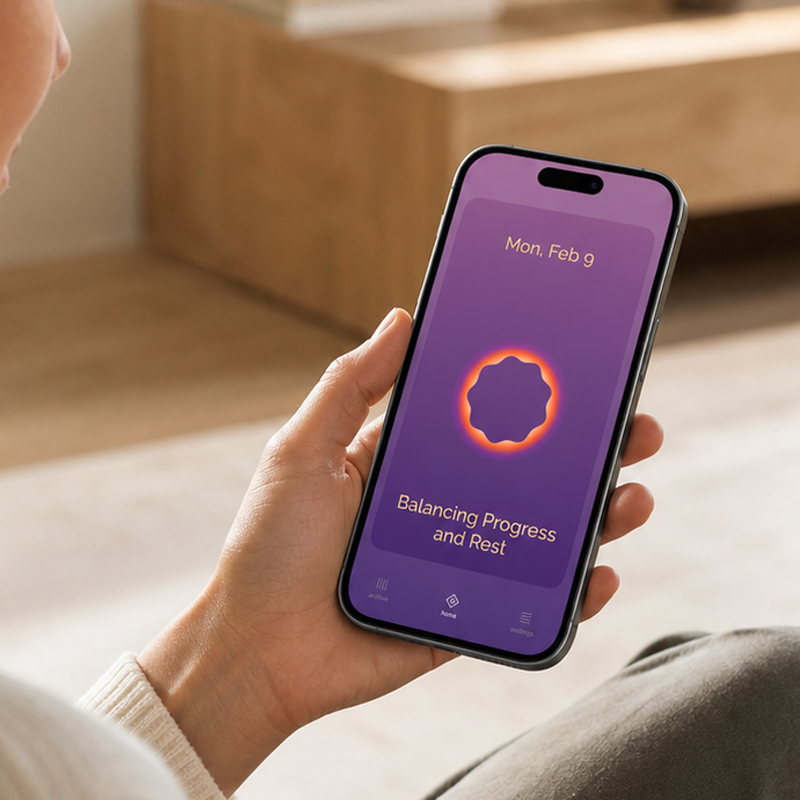
Open-ended AI was the wrong interaction model for a clinician-supervised product. The work began by defining what the system must never become: a substitute therapist, an unbounded chatbot or a central store of sensitive patient history. Those constraints became the architecture.
The system needed enough flexibility to feel personal, but not enough freedom to redefine the clinical relationship.
Clinical expertise had to shape behaviour through a usable product surface rather than technical model controls.
Useful sharing had to coexist with an architecture designed to minimise centrally held sensitive content.
The visible experience is a patient speaking and receiving a short reflection. Making that moment dependable required three connected systems: a resilient voice application, an expert-configurable generation layer and a data architecture that limits what the platform can know.
Voice capture, processing and generated playback cross device and network boundaries. A fragile connection or unclear state could make a sensitive interaction feel broken—or make a patient unsure where their recording had gone.
We separated the local experience from network-dependent generation. Native capture, playback and reflection history remain responsive and available offline; asynchronous processing is treated as an explicit state rather than hidden latency. Device security and biometric access are part of the foundation, not a later layer.
Network work is exposed as state. The daily practice remains available without it.
Free-form prompting asks clinicians to become prompt engineers and makes output quality difficult to predict. Hard-coded templates are safer, but cannot reflect different therapeutic methods, voices or patient needs.
We built a structured authoring layer that turns clinician choices into a versioned behavioural configuration. At runtime, patient input is combined with the correct active configuration inside a constrained generation process. Clinicians control intent and boundaries; the product owns the technical translation.
The easiest architecture would centralise recordings, transcripts and reflections. It would also create a durable repository of exceptionally sensitive content—and make broad access the default.
We inverted that model. Patient content remains under patient control, while sharing is explicit and item-specific. Selected recordings are protected before transmission, readable only at the destination and automatically removed from temporary platform storage within a short window. The infrastructure coordinates access without becoming the long-term content owner.
A three-week feasibility and acceptability study with 27 participants tested the assembled system in practice: whether people could use it, whether the experience felt coherent and whether the interaction was worth continuing.
These results are early feasibility signals, not claims of clinical efficacy. They support the product mechanism and provide a foundation for further evaluation.
The most valuable output was not one application, but a repeatable way to build AI systems where domain experts set the boundaries, users retain control of sensitive data and model behaviour must remain legible.